Corrado Gini - Unwashed
Yes, it is about the "Gini Coefficient" guy

You will not find another measure of macroeconomics so ubiquitous as the Gini coefficient which has been named after an individual. [There is Tobin's-q, but it is only for real economics nerds.]
https://data.worldbank.org/indicator
A darker shade of Gini
"It is no accident that the inventor of the still most widely used measure of national inequality, Italian statistician Corrado Gini, was a Fascist." Samuel Moyn, Kent Professor of Law and History at Yale University. [I disagree with Moyn on one count: Gini coefficient is one summary of the Lorenz curve - analyzed by Max O Lorenz’s “Lorenz Curve” - with great mathematical elegance - years before Gini. “Invention” would be an overkill in the sentence I quote from Moyn.]
Gini-Mussolini Nexus
While working for various labour organizations in Switzerland, Benito Mussolini made a name for himself as a charismatic personality and a consummate rhetorician. After returning to Italy, he amassed a large following while working as an editor for the socialist magazine “Avanti!”.
His political beliefs took a hairpin turn to the right midway through World War I, when he stopped decrying the war effort and began advocating for it. After World War I he began organizing fasci di combattimento — nationalist paramilitary forces known for wearing black shirts. These groups began waging campaigns of terrorism and intimidation against Italy’s leftist institutions at his behest.
In 1922 Mussolini and other fascist leaders organized a march on Rome with the intention of forcing the king to yield the government to Mussolini. It worked, and Mussolini was appointed prime minister that same year. By 1925 Mussolini had dismantled Italy’s democratic institutions and assumed his role as dictator, adopting the title Il Duce (“The Leader”).
Benito Mussolini was Europe’s first 20th-century fascist dictator. But Mussolini’s political orientation didn’t always lean that way. His father was an ardent socialist who worked part-time as a journalist for leftist publications. His father named him "Benito" after the first (and only) indigenous president of Mexico: Benito Juarez.
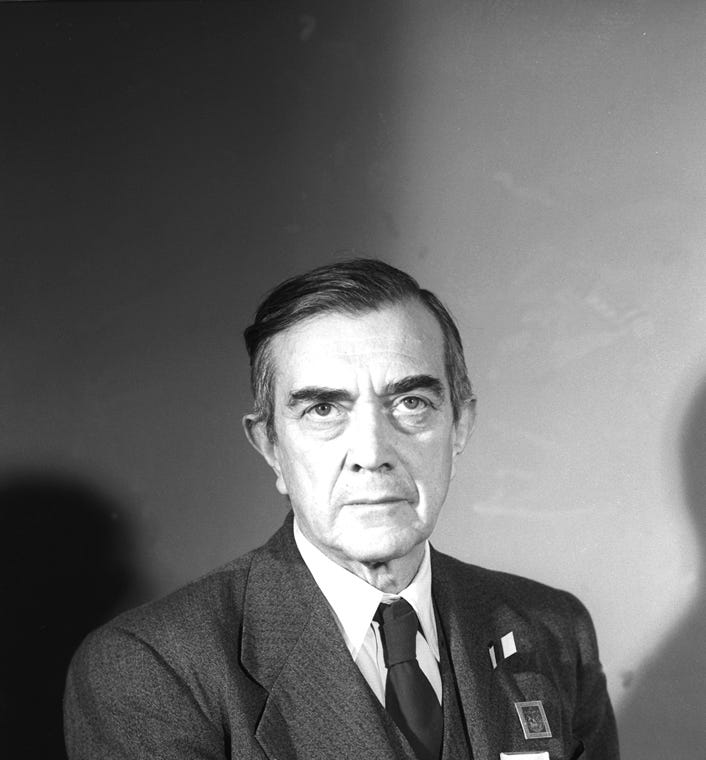
Gini saw Mussolini as a Savior
Gini wasn’t just any fascist, either. He extolled effusively about the virtues of fascism. He was the author of the paper: "The Scientific Basis of Fascism" published - not in some obscure Italian rag but in the Political Science Quarterly, Vol. 42, No. 1 (Mar., 1927), pp. 99-115. Oxford University Press - the leading political science journal in the world at the time.
It is worth quoting how he saw Fascism and Mussolini as the leading edge of science:
"The march to Rome might conceivably have resulted in a revolution but in point of fact it was limited to an armed demonstration, the king having given his adhesion to the movement. Thus Mussolini arrived in power in an absolutely legal fashion; and thereafter, he took every precaution to keep within the bounds of formal legality all the measures of an exceptional character which his government adopted. Quite apart from the question of form, the action of the Fascist administration, once it had acquired power, was not shaped in the way in which, generally, revolutionary action is understood to go, namely, to substitute for a limited governing class the control of somewhat more extensive social groups; but rather was it directed to augmenting the power gathered in the hands of those who had managed to establish themselves in control.
From this point of view, the development of the Fascist administration may be thought to resemble not so much a revolution in process as a succession of coups d'etat.
On the other hand, the success of a government in which the effective administration of authority is confined to one person or a few persons depends, in the last analysis, upon the quality of this person or of these few persons. The conviction is widely held in Italy that the Fascist regime could hardly have succeeded or persisted if it had not had at its head an individual of the exceptional qualities of Mussolini; and this explains the authority, almost unlimited in extent, which he possesses among the Fascists, and the respect which even those who are wholly opposed to his regime, or indifferent to it, have for him personally.
There can be no doubt that the Fascist experiment has had highly satisfactory results in Italy. Among those who have had an opportunity to compare the present situation of Italy with that which existed under the preceding administrations, there is no uncertainty whatever in this connection.' The concentration of power in the hands of few men has permitted the revaluation of national ideals, the reestablishment abroad of the prestige of Italy, and the restoration of domestic order."
Gini's storytelling differs markedly from how historians see it. For example, his story of "Thus Mussolini arrived in power in an absolutely legal fashion; and thereafter, he took every precaution to keep within the bounds of formal legality all the measures of an exceptional character which his government adopted." is utterly false. His characterization "The conviction is widely held in Italy that the Fascist regime could hardly have succeeded or persisted if it had not had at its head an individual of the exceptional qualities of Mussolini." is questionable. Had Mr Mussolini not been jailing and torturing his opponents by the use of the Black Shirt Brigade, it would have been impossible for Mr Mussolini to stay in power.
It would have been impossible for Professor Gini being unaware of that.
Why?
He was conducting public polls to gauge the support for Mussolini!
He would have definitely known the truth.
As a reward for his support for Mussolini, he was appointed full professor at the University of Rome.
There, he founded a lecture course on Sociology, which he maintained until his retirement. He also set up the School of Statistics in 1928 and the Faculty of Statistical, Demographic, and Actuarial Sciences in 1936. In 1929, Gini founded the Comitato italiano per lo studio dei problemi della popolazione, which, 2 years later, organized the first Population Congress in Rome. In 1926, Gini was appointed as President of the Central Institute of Statistics in Rome.
He did himself a favor. He resigned in 1931, in protest at interference in his work by the state. In 1934, Gini founded the journal Genus, which became the official journal of the Italian Committee for the Study of Population Problems.
Before World War II, Gini received numerous honors: he became an Honorary Member of the Royal Statistical Society (1920), Vice President of the International Institute of Sociology (1933; he later became president in 1950), President of the Italian Society of Genetics and Eugenics (1934), President of the International Federation of the Society of Eugenics of the Latin language countries (1935), President of the Italian Society of Sociology (1937), Honorary Member of the ISI (1939), and President of the Italian Statistical Society (1941–1944).
In 1943, Mussolini resigned and the Fascist party in Italy was dissolved. Gini’s position was not an easy one - he had been close to Mussolini but he had also shown his opposition to racist policies. During the summer of 1944, Gini was investigated for his role in the wartime regime. He had to leave teaching and his positions as Dean of the Faculty of Statistical Sciences and President of the Italian Statistical Society. In 1945, Gini was suspended from all academic duties and his salary was not paid for 1 year. In 1946, he resumed his duties at the Faculty and in 1949 again became President of the Italian Statistical Society, a position he held until his death. After this experience, his departure from politics was almost complete, and the last 20 years of his life were mainly devoted to his studies. In 1955, he was nominated as Professor Emeritus. In 1962, he became a national member of the Accademia dei Lincei. Corrado Gini passed away in the early morning of March 13, 1965.
Executive footnote: Gini was never convinced that the “Normal” distribution is the “natural” state of the world. He believed the world is inherently unequal - whether it is the question of income or height of humans or intelligence. This is consistent with his belief about fascism - and that strong men will save the world. We hear echoes of this in different parts of the world in 2024 from pronouncements of some successful politicians and business people including Ms Georgia Meloni - the Italian head of state - a direct link to Mr Mussolini as his granddaughter.